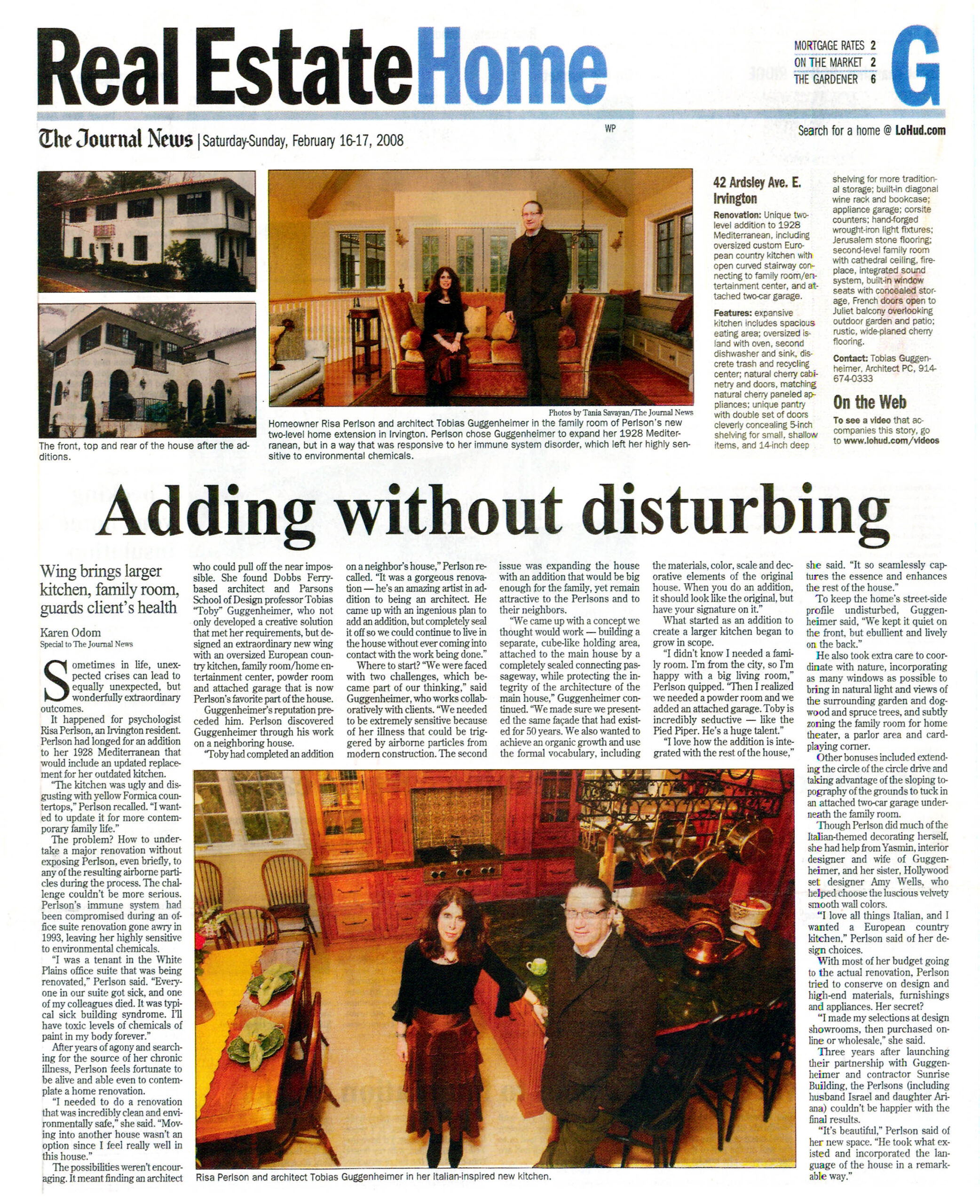
Real Estate Home
The Journal News | Saturday-Sunday, February 16-17, 2008
(Photos by Tania Savayan/The Journal News)
The front, top and rear of the house after the additions.
Homeowner Risa Perison and architect Tobias Guggenheimer in the family room of Perison’s new two-room extension in Irvington. Perison chose Guggenheimer to expand her 1928 Mediterranean, but in a way that was responsive to her immune system disorder, which left her highly sensitive to environmental chemicals.
Adding without disturbing
Wing brings larger kitchen, family room, guards client’s health
Karen Odom
Special to The Journal News
Sometimes in life, especially unexpected events, give rise to clarity.
It happened for psychologist Risa Perison of Irvington recently. She had long considered expanding her 1928 Mediterranean home. But after two immune system-related emergency trips to the hospital left her unable to enter the world beyond her yard for fear of toxic exposure, she finally sought a complete renovation.
“I’m sensitive to chemicals,” Perison said. One day, she had a violent reaction to a new fan installed in her kitchen. “Through my illness, I realized a lot about what is important to me,” she said. “I really wanted to keep the integrity of the house. I see my illness as a message. It meant finding an architect who could pull off the near impossible. She found Dobbs Ferry-based architect and Parsons School of Design professor Tobias ‘Toby’ Guggenheimer. Not only could he envision a renovation that would blend seamlessly and not disturb the existing structure and extraordinary views, but he also could design it in a way that wouldn’t worsen Perison’s immune disorder.
The fact that a good architect blends art, science and practicality is well-known. But there was something extraordinary about what embedded in the problems that confronted Perison. “Everything was different,” Guggenheimer said. “She had issues that dictated a style of design that was specific to her needs.”
With her home perched on a slope overlooking the Hudson River, Perison wanted the addition to be harmonious. “I love the rustic nature of the house,” she said. “Strong elements of Italian architecture. I felt that expanding the house made sense: easier for me to get around.”
In addition to being highly sensitive to chemicals, Perison also battled chronic fatigue syndrome — another reason she needed help customizing her home.
“This is the first real renovation I’ve done in my whole life,” Perison said. “It sometimes feels like I really went to design school. I love renovations online so I felt really ‘tuned in’ to this house. I see my illness as a message. It meant finding an architect.”
Toby had completed an addition on a neighbor’s house,” Perison recalled. “He was a gorgeous renovation — being an artist and accustomed to being an architect is often akin to living with an impervious plan to the world and organizing it.”
The situation was unique: How to add to the house without creating something too different or too “off”? “We’ve been coming in under the budget,” said Guggenheimer. “Everything is contextual — the spirit, the language, the material vocabulary. It’s all there.”
There were two issues for Perison. The first was her illness that could be triggered by the chemicals used to bring modern construction. The second issue was expanding the house with an addition that would fit behind the family, yet remain attractive to the Perisons and to their neighbors.
“We created two rooms: a new great, superb, walk-in landing area, complete with molding everywhere,” said Guggenheimer. “A family room and complete kitchen that carry out the architecture of the rest of the home while respecting the grammar of the house that was there for 80 years. We also wanted a more organic graphing with the formal vocabulary, including the materials, color, scale and decorative elements of the original house. When you do an addition, it should look like it belongs — but you want differentiation so that it doesn’t seem like an added growth, graft or a large kitchen hedged to create a space.”
In fact, Perison needed a family room where she could do her work without disruption. Tired from the renovation, she appreciated Guggenheimer’s vision so deeply. “I think Toby is one of the few who could understand my vision and everything was perfect,” she said. “It so seamlessly captures the essence and enhances the rest of the house.”
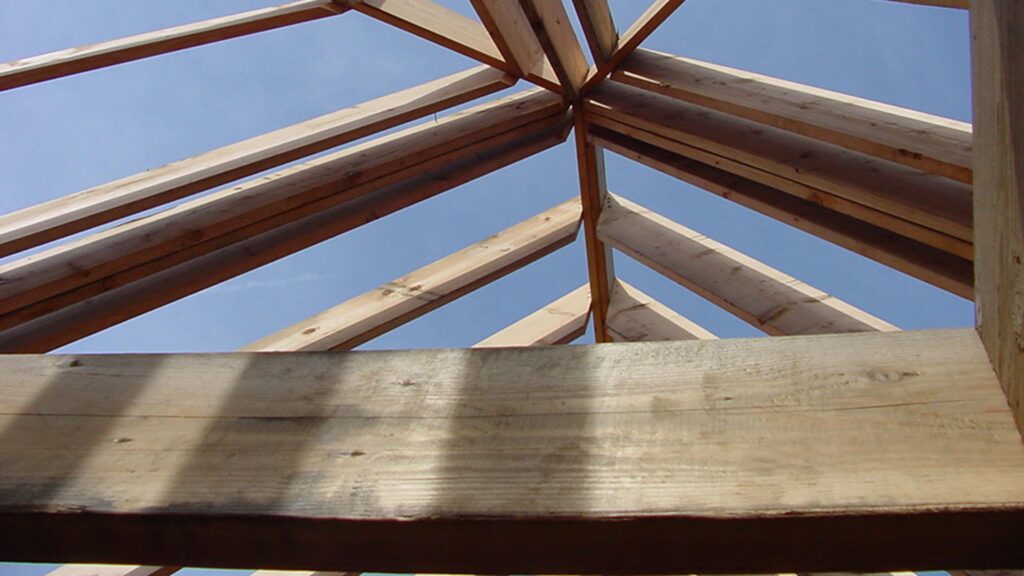
The top job featured a new roofline and interior, Guggenheimer said.
He created an exotic copper cooking countertop to balance the new kitchen machinery that Perison wanted. “It needed something to soften the space,” she said.
The new family room and kitchen form an integrative composition — but they remain separate. The new structure is perfectly aligned with the original structure of the home and does not overpower it.
Perison’s house once had a tiny kitchen that needed extending. She has a new culinary space with crafted wood cabinetry including deep wood drawers and shelving for more traditional kitchen built-in diagonal framing and more storage space. A mix of reclaimed flooring, granite countertops, pendant lighting, bamboo soffit flooring, cork flooring, red-hued wood cabinetry and copper accents makes the redesigned kitchen feel very inviting.
Guggenheimer, Tobias Guggenheimer Architect, P.C., 914-693-2727.
42 Ardsley Ave. E., Irvington
Renovation: Unique two-story addition to 1928 Mediterranean house
Goal: Respect original home’s architecture, protect health of chemically sensitive homeowner
Features:
– New family room
– New kitchen
– Reconfigured interior
– Traditional materials used sensitively
– Design that relates to existing forms, color, scale, detailing
– Italian-inspired kitchen
– Reclaimed wood flooring, granite, copper, and bamboo
– Architect: Tobias Guggenheimer, Parsons School of Design professor, author, and principal of Tobias Guggenheimer Architect P.C.
On the Web
To see a video that accompanies this story, go to:
www.lohud.com/videos
Photo caption (bottom):
Risa Perison and architect Tobias Guggenheimer in her Italian-inspired new kitchen.