BY BILL FALLON
bfallon@westfairinc.com
At SUNY Binghamton, Tobias Guggenheimer majored in English and displayed a knack for the lost wax method of bronze casting in studio art classes. He completed the academic trifecta of dubious employability by also studying journalism.
He thought he might teach English literature.
And so, perhaps, our story should end here: another creative literary type – in the worst-case scenario a poet – crashing on friends’ couches through to senility; a cautionary tale to study engineering or computers.
But Guggenheimer kept turning pages, kept active and kept making things happen. He’s big like a lineman, 55 years old and, perhaps unique for that age, sporting a pony tail that doesn’t look like a midlife cry for help by guys who majored in English and lost wax.
After college, he returned to Switzerland, where he was born. There, he befriended young architects. (He speaks Swiss German.) He also traveled to Israel, where he had lived as a child in the ’50s (he speaks Hebrew) and where buildings old and new caught his attention: “They’d be digging a foundation and find Herod’s palace.”
He returned to Evergreen, Colo., worked in construction and set about building himself a house – “Sheetrocker. Plumber. Carpenter. Finish carpenter. Foundation to roof.” – entirely of recycled materials. “I wanted to be high-minded and practical.”
Also in Evergreen, he began designing buildings.
He codified his homegrown skills with a degree in architecture from the University of Colorado.
Guggenheimer returned to New York in 1986 for an architecture internship. He opened Tobias S. Guggenheimer Architect P.C. in Dobbs Ferry in 1991.
The firm employs five in Dobbs Ferry and another five at a second office in the Philippines.
He has taught for 20 years: college-level architecture and design, including 13 years at Brooklyn’s Pratt Institute. His teaching, he says, keeps him in tune with the philosophy of architecture, plus, “I enjoy it.” He is now on the faculty of Parsons School for Design in Greenwich Village.
Guggenheimer defines his field as “the manifestation of culture responding to its physical environment – an amalgam of art, science and philosophy.”
But, “Unlike pure art, it has to respond to many real-world constraints.” He points out several such constraints: legal compliances, client interests, earthquakes and winds that can blanket the face of a building with millions of pounds of pressure. “There are also tremendous economic pressures by virtue of the fact the design fee has to be recovered in the expense of the structure.”
Guggenheimer is a student of architecture. He wrote “A Taliesin Legacy: The Architecture of Frank Lloyd Wright’s Apprentices” (Wiley Press, 1995). “It’s a study of Frank Lloyd Wright’s philosophy and whether he was able to translate it to his students. He was a gifted architect, philosopher and cultural critic. He argued that every culture had to develop a strength and resonance that would lead to its own style and translate across the board.” Up until this point – early 20th-century – American arts had been derivative of European tastes, as with the columned architecture of Washington, D.C. “I would say he was in the vanguard of culturally self-conscious Americans.” Of Wright’s Usonia development in Pleasantville, Guggenheimer says, “I love it.”
Guggenheimer arrives with a portfolio of his work and it is stunning: traditional gabled mansions to hip city waterfront condos that resemble boats. His firm is currently wedding a fresh food market to a subway stop at Broadway and Houston Street, “The gateway to SoHo.” Citing more of those constraints unique to architecture, the MTA is now conducting a subterranean review of the SoHo property before construction begins.
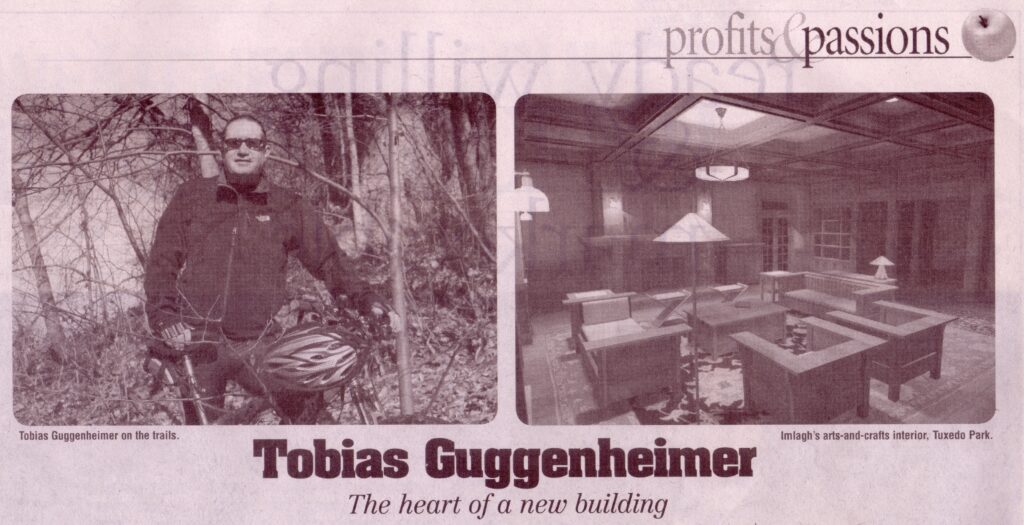
Guggenheimer is currently finishing interior work on Imlagh, a Tuxedo Park mansion into which he wove 13 miles of computer wires. In the rarefied world of such addresses, the owner has sent Guggenheimer to Sri Lanka, India, Bhutan, Nepal, Thailand, Vietnam, Hong Kong, China and the Philippines on several trips to gather the aesthetic touches that make 16,000 square feet a home. “Despite the fact it was costly, it probably only cost 20 percent of what he would have spent on Madison Avenue for the same stuff.”
Since he began redesigning Imlagh, he and the owner have become friends and biking and hiking buddies.
Guggenheimer is married to second wife Yasmine, an interior designer who also works at the firm. He has two daughters: Anna Bella, 27, and Leanora, 21.
Weekends and when he is abroad, Guggenheimer is an active cyclist. It’s no surprise; as he says: “I grew up with bikes. As a kid, I wouldn’t pick up the phone, I’d pick up a bike to visit a friend.” As a 20-year-old, he led 10 teens 750 miles across New England by bike. He and his friends are now regular Sunday riders in northern Westchester and Tuxedo Park. A photo reveals his bike – a Specialized – incorporates all the latest two-wheeled shocks and gadgets.
To keep fit when the trails are impassable, he hikes and works out in the gym. He and his Imlagh client last year hiked in Nepal at altitudes above 10,000 feet. Guggenheimer was in shape, but the rigors of hiking at 13,000 feet – his top altitude – had him chugging tea to keep going. “The caffeine would kick in and I’d be fine for two hours. Then I’d crash and need more tea.”
Wherever he goes, Guggenheimer balances the yin of architecture with the yang of the natural world. Back in the office, he draws from both: “We design to be world-friendly, pedestrian-friendly, bike-friendly and ecologically friendly,” he says. “We work to limit each building’s impact and work to be as green as our clients will allow us to be.”
SUCCESSFUL BUSINESS PEOPLE HAVE MANY DIMENSIONS, THEY EVEN MANAGE TO HAVE SOME FUN. WESTCHESTER COUNTY BUSINESS JOURNAL – MARCH 24, 2008 — 59